
Between Data and Action
The data is available. Yet day-to-day operations still involve a great deal of improvisation.
Organisations collect more operational data than ever before. Systems provide status information, dashboards visualise developments and planning tools define schedules, tasks and responsibilities.
At first glance, everything required for informed decisions appears to be available.
But available information does not automatically lead to effective action.
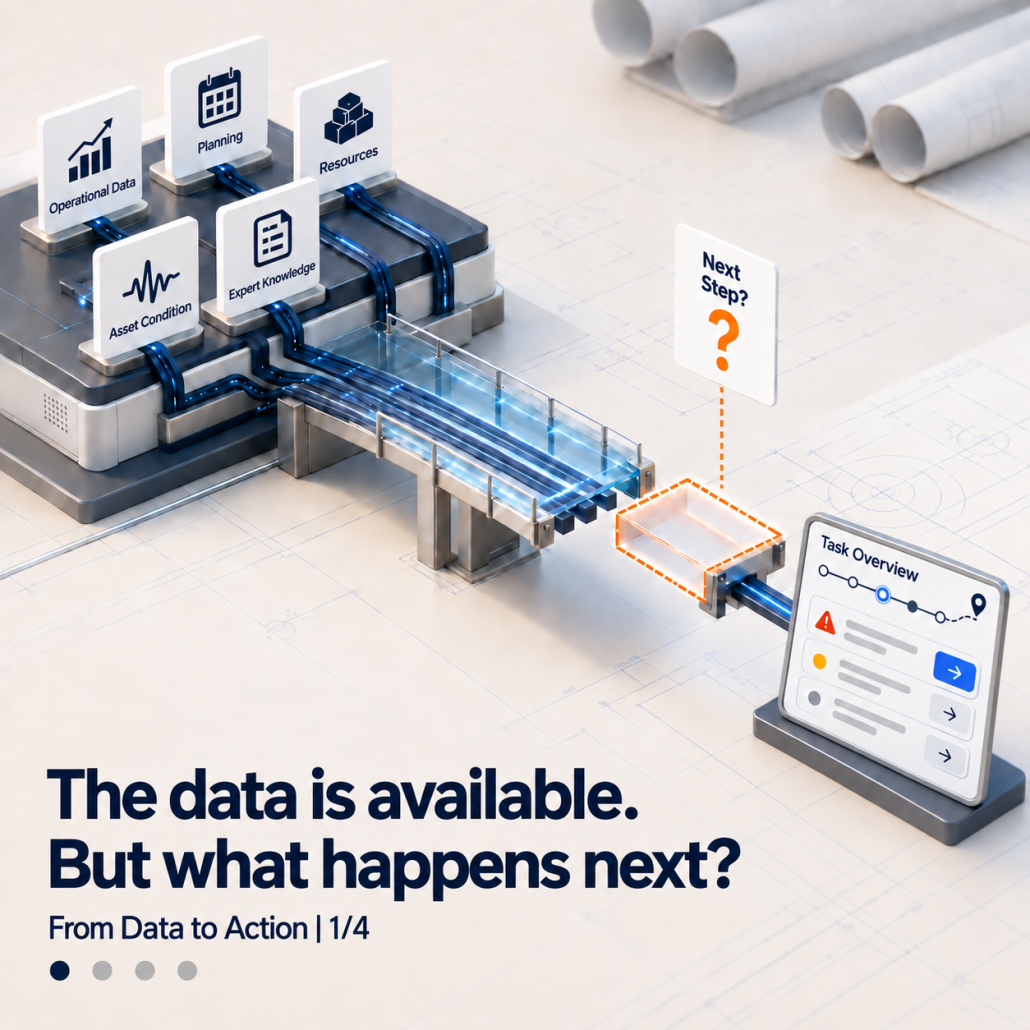
The gap between insight and execution
At DATAbility, our roots lie in maintenance and industrial service. One lesson from this environment has shaped how we approach operational intelligence:
A detected deviation does not repair a machine. A forecast does not organise a service assignment. And a dashboard does not decide which task should take priority when conditions change.
Between recognising a situation and responding to it, several questions still need to be answered:
- What has changed?
- Which tasks and processes are affected?
- How urgent is the situation?
- Which dependencies need to be considered?
- What resources are currently available?
- And what is the most appropriate next step?
These decisions rarely depend on a single data source. They require information from operational systems, plans and schedules, technical documentation, resource availability and the experience of the people involved.
Why static planning reaches its limits
Operational plans are created based on the information available at a particular point in time. Once operations begin, however, the underlying conditions continue to change.
Delays develop. Priorities shift. Resources become unavailable. New service requirements emerge. Technical problems affect planned sequences.
The original plan may still be visible in the system, but it no longer reflects the actual situation.
Operational teams then have to interpret the changes, assess their impact and coordinate an appropriate response—often under considerable time pressure. This work frequently takes place through phone calls, messages, spreadsheets and individual experience.
The data may be digital, while the decision-making process remains largely manual.
From operational data to decision support
This is why we look beyond data collection and visualisation.
For us, Operational Intelligence means connecting relevant information in a way that supports decisions during ongoing operations. The objective is not to automate every decision or remove people from the process. It is to provide a reliable basis for action when conditions change.
This includes:
- continuously incorporating current operational data,
- recognising relevant deviations at an early stage,
- making dependencies and possible consequences visible,
- reassessing tasks and priorities,
- and providing understandable recommendations for the next operational step.
Clear situations can be prepared efficiently. Uncertainty should remain visible. Complex cases can then be directed to the people with the appropriate operational knowledge.
Making information operationally useful
The decisive question is therefore not simply whether data is available.
It is whether the available information helps operational teams understand what is happening, what it affects and what they can do next.
Closing this gap between information and action is one of the reasons we work on Operational Intelligence—and the starting point for our work with DispoClean.
In the next article, we look at a specific application from railway cleaning and explore what dynamic operational planning requires in practice.

