
Digital Orders, Manual Work
“Our orders already come in digitally.”
We hear this frequently in conversations with customers. And at first glance, it is true: the order arrives by email, line items are attached as a spreadsheet, and technical specifications can be found in a PDF or image.
But digital input does not automatically create a digital process.
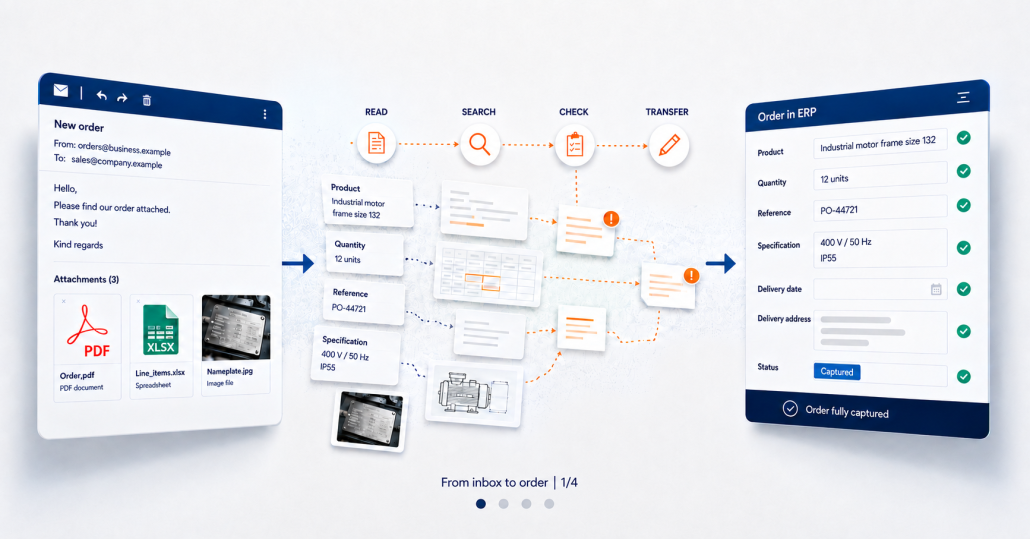
The work begins after the email arrives
Before an order can be entered into an ERP system, employees may need to:
- open and review several attachments,
- identify the relevant products and quantities,
- interpret customer-specific product descriptions,
- compare information with quotations or master data,
- search for missing technical specifications,
- clarify inconsistent details,
- and manually transfer the results.
Once the process is complete, the ERP system shows a structured order. What it does not show is the work required to create it. This is why the actual effort involved in order processing is often underestimated. The final data entry is visible and measurable. The many small decisions leading up to it are distributed across emails, documents, systems and individual employees.
Why this matters
Each individual step may only take a few minutes. When the same steps are repeated across hundreds of orders, however, they consume a significant amount of time.
They also create operational risks. Information can be overlooked, product variants can be confused and specifications can be transferred incorrectly. As order volumes and product complexity increase, adding more manual effort is rarely a scalable solution.
Looking beyond the digital inbox
At DATAbility, this is one of the reasons we work on Order Intelligence. The starting point is not the question of whether an email can be read automatically. It is the question of where manual work still occurs despite digital order intake.
Making this hidden work visible is the first step towards improving the process. Only then can organisations decide which activities can be automated, which require validation and where human expertise remains essential.
A digital order is therefore not the end of digitalisation. It is where the real process begins.
