
Why Data Extraction Is Not Enough
“Can’t AI simply read the order?”
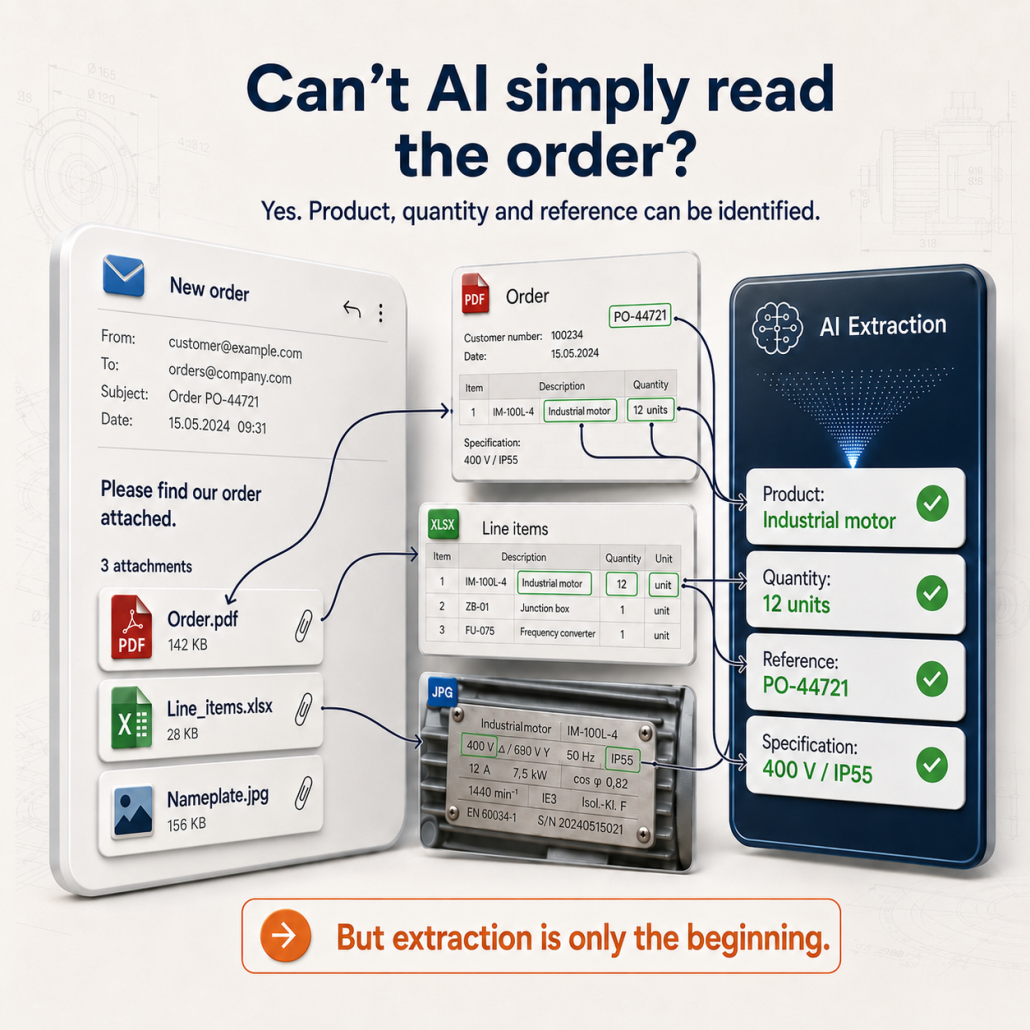
Yes, it can. AI can identify text, tables and values in emails, PDFs, spreadsheets and images. But extracted information is not automatically reliable order data.
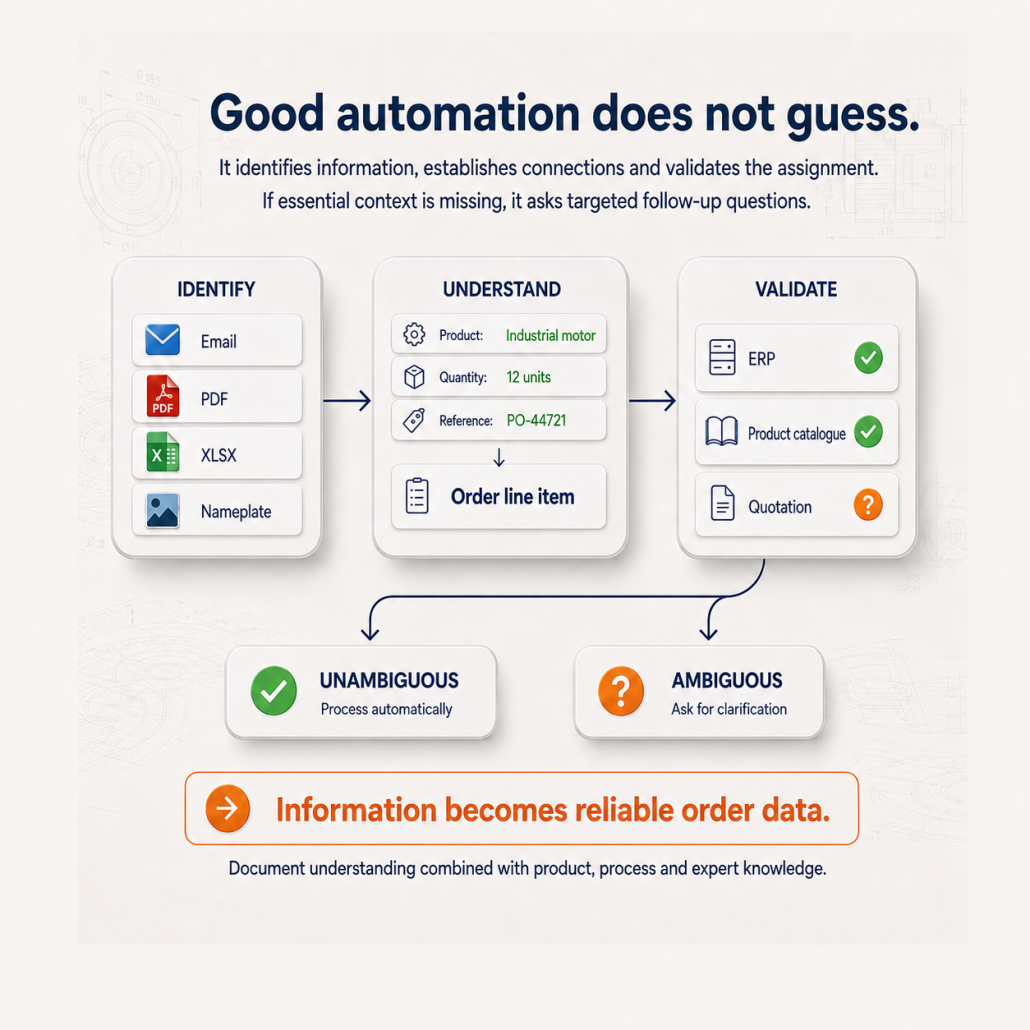
Before it can be transferred to an ERP system or used in an operational process, three things need to happen.
1. Identify the information
The first step is to recognise the relevant products, quantities, references and technical specifications.
This can already be challenging when information is distributed across several attachments or when customers use their own terminology instead of the official product description.
A number, for example, might refer to a product, a machine, a quotation or a previous order. Extraction makes the information visible, but it does not yet establish its meaning.
2. Understand the relationships
Recognising individual values is only the beginning. The system must also understand how they relate to one another.
Which quantity belongs to which product? Does a specification describe the requested component or the machine in which it will be installed? Which reference belongs to which order line?
Without these relationships, extracted values remain isolated pieces of information rather than actionable order data.
3. Validate the result
The identified information must then be compared with reliable sources:
- Does the product exist in the catalogue?
- Does the description match the ERP master data?
- Is the requested configuration technically possible?
- Does the information correspond with an existing quotation?
- Are all mandatory details available?
Validation is what turns extracted information into dependable operational data.
When the request remains unclear
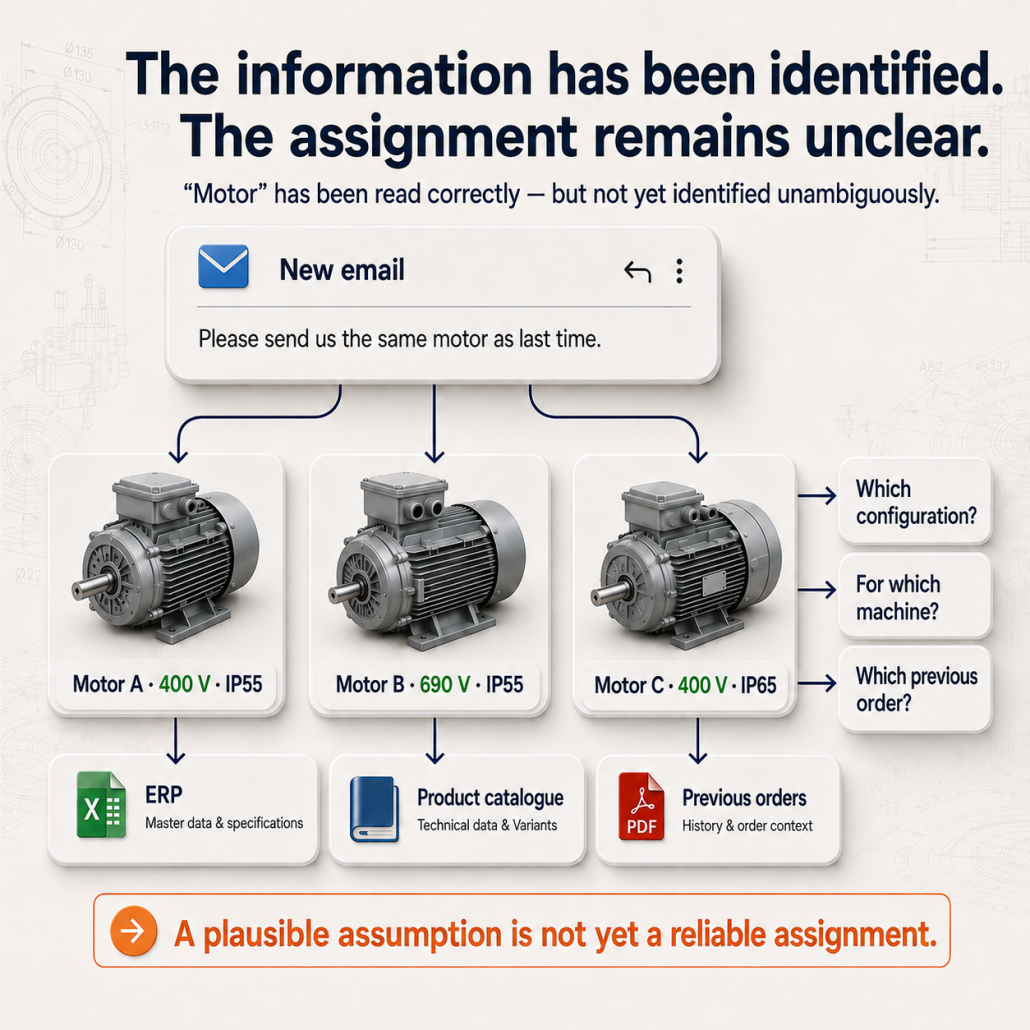
Consider this customer request: “Please send us the same motor as last time.”
The sentence is easy to read, but its meaning is not clear.
- Which motor?
- Which configuration?
- For which machine?
- And which previous order is relevant?
An automated system might select the most likely result. But a plausible answer is not necessarily the correct one.
Good automation should therefore make uncertainty visible instead of hiding it. If essential context is missing, the system should identify the possible options and initiate a targeted clarification.
Keeping people in control
Order Intelligence does not have to mean fully autonomous processing.
Users should be able to review the extracted information, understand how it was assigned and intervene whenever necessary. They can correct individual values, select the appropriate product variant or approve the completed order before it is transferred to the ERP system.
This creates a meaningful division of work:
- Clear and recurring cases can be prepared automatically.
- Missing or contradictory information is highlighted.
- Ambiguous cases are directed to the appropriate employee.
- Users can review, correct and approve the result.
The automation supports the decision. Decision-making authority remains with the user.
From extraction to Order Intelligence
At DATAbility, we therefore look beyond document extraction. The objective is to combine document understanding with product data, technical knowledge, existing systems and human expertise.
Effective Order Intelligence identifies information, establishes the relevant relationships, validates the result and recognises uncertainty.
Because good automation does not guess. It knows when the available information is sufficient — and when it is time to ask.

