
The Context Is Rarely in the Email
Where does the necessary context come from when an order is ambiguous?
In customer projects, we repeatedly hear statements such as:
“Ask Ms Miller—she knows what the customer means.”
Experienced employees understand customer-specific terminology, previous orders, special configurations and technical dependencies. They also recognise when information is incomplete and clarification is required.
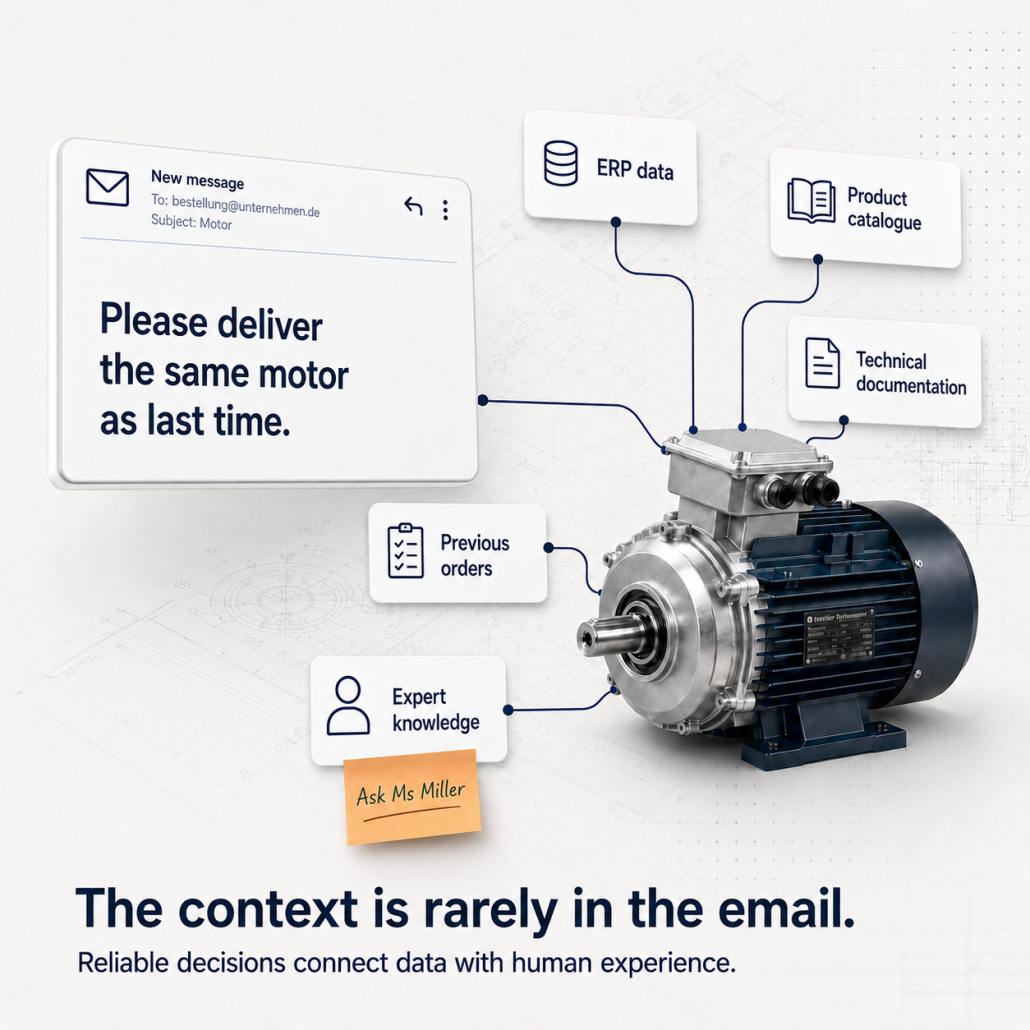
Context is distributed
This knowledge is extremely valuable, but it is rarely contained in the order email—or stored in one central location.
The context required to understand an order may be distributed across:
- ERP and master data
- Product catalogues
- Technical documentation
- Previous orders and quotations
- Customer-specific information
- Employees’ practical experience
A previous order might identify the product, while technical documentation explains the required configuration. An experienced employee may know that the customer uses a particular abbreviation or that a certain component only fits a specific machine.
Connecting data and experience
At DATAbility, we focus on connecting these different sources and making the relevant context available within the process.
The objective is not to replace employee experience. Instead, technology should make existing knowledge easier to access and reduce the time spent searching across documents and systems.
Clear cases can be prepared efficiently, while ambiguous requests remain visible and are directed to the appropriate expert. Employees can review, correct and approve the proposed information at any time.
Good Order Intelligence therefore combines data, context and human judgement—making experience accessible without taking decision-making authority away from the people responsible.

